Equine muscle trauma
Muscle tears and trauma
Muscle is fairly easy to tear and has minimal capacity for regeneration. Repair occurs by replacement of muscle fibers with scar tissue.
Muscle tearing results in hematoma formation and mild signs of inflammation. In horses, the hematoma typically resolves into a seroma and then is absorbed by the body.
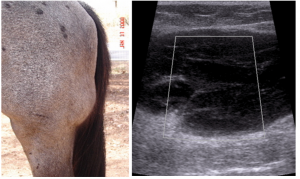
Scar tissue replaces the torn muscle and can restrict motion. As scar tissue doesn’t stretch, recurrent tearing is common.
Healing is usually rapid unless a large hematoma forms. Hematomas can take months to resolve.
Stall rest is generally contraindicated, even with large tears. If stall rest is needed for initial care, immobilization should be restricted to 5 days whenever possible. Longer immobilization leads to muscle atrophy and excessive scar formation. Initial therapy typically includes controlled walking and gradually increasing isometric exercises starting day 3-5 after injury. Isometric contraction exercises help regain strength without stretching the injured muscle. Examples include wither pulls, lateral tail pulls and caudal tail pulls. As the horse gains strength, isometric exercises are ideally followed by dynamic mobilization and core strengthening exercises. Human athletes that follow protocols including trunk stabilizing and core strengthening exercises decreased their chances of reinjury compared to athletes that focused solely on the injured muscle. Tactile stimulators, resistance bands, ground poles, hill work, treadmills and swimming/aquatreadmills may be used carefully to regain mobility and strength when horses have sustained more severe injuries or muscle atrophy.
Resources
Traumatic Muscle Injuries, (2025). Veterinary Clinics of North America: Equine Practice. 41.10.1016/j.cveq.2024.11.009. – nice review of options
Muscle Rehabilitation Techniques and Prevention of Injury (2025) Veterinary Clinics of North America: Equine Practice, pp193–211;
https://doi.org/10.1016/j.cveq.2024.11.010
Therapeutic Exercises for Rehabilitation of Muscle Injury . (2025). Veterinary Clinics of North America: Equine Practice. 41. 10.1016/j.cveq.2024.11.011.